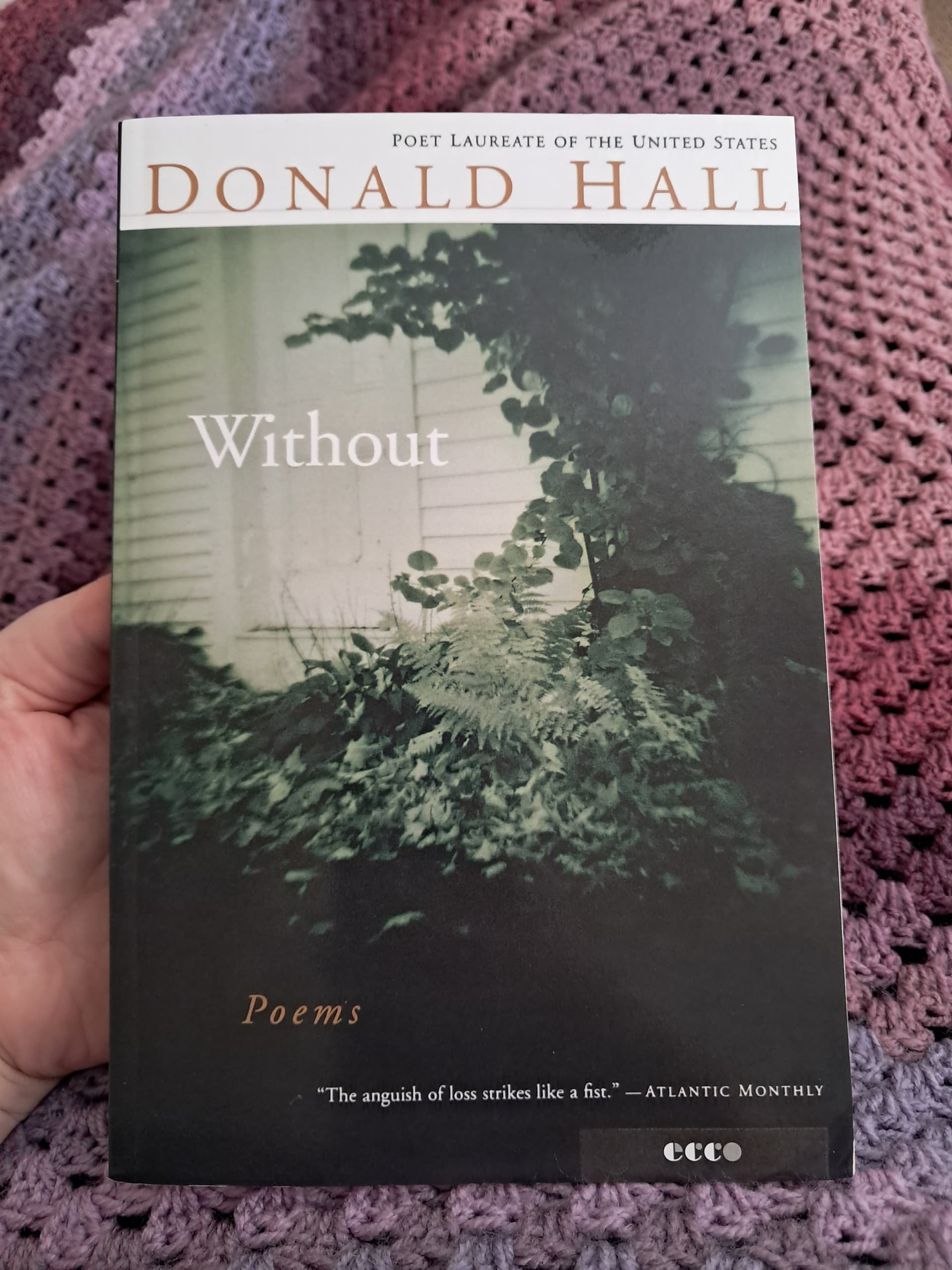
A year ago, this was my mother's last full day of life. Looking back, I now know this was the eve of her death.
I started reading a biography of Jane Kenyon—one of my favorite poets—while my mother was in the hospital last year. I continued to read it when she entered hospice and after she died of cancer. Kenyon died of leukemia in 1995. Her husband, fellow poet, Donald Hall, cared for her throughout the ordeal. He was so in love with Kenyon that he wrote several books about his grief for her, including the poetry collection pictured above: Without.
The poems in the collection recount Kenyon's dying process and the year after her death. I picked the book up today because I wanted to be held by poetry. Often, language brings me the deepest solace. I have lived through something enormous. No one truly understands it, but I feel that poetry and literature and art are often the only things that recognize the enormity of loss.
I secretly wanted the life of Jane Kenyon and Donald Hall. I always admired their relationship. Two poets living in a farmhouse in New Hampshire, loving and caring for one another. I imagined being with a partner, a fellow writer as passionate as me, the two of us spending our days writing and reading. I fantasized about the house, the bookshelves, the feeling of safety and connection.
It's always moved me how affected Hall was by Kenyon's death and how he used poetry to keep her present and to continue loving her. His poems are very raw and vulnerable. He was unafraid of expressing the agony of losing his beloved.
Women are often warned by oncologists that their husbands might leave them when they are diagnosed with cancer. Hall stayed by Kenyon's side and accompanied her through the brutal chemotherapy that did little to prolong her life. He did not move on or quickly get over her. She loomed over his life and his writing until his own death in 2018.
Here are some of my favorite passages from the book:
When I try talking with strangers
I want to run out of the room
into the woods with turkeys and foxes.
I want to talk only
about words we spoke back and forth
when we knew you would die.
I want never to joke or argue
or chatter again. I want never
to think or feel.—from "Letter at Christmas"
Your presence in this house
is almost as enormous
and painful as your absence.— from "Letter with No Address"
Art was dependable, something
to live for.— from "Blues for Polly"
"After the Flood" by Talk Talk
Alone, the crowd
Spurning step by state
Blame something else
Thirsting
Within and without